

You extend wifi signal to the backyard for cameras and speakers by wiring a dedicated outdoor access point back to your router, not by pointing an indoor extender at a window. Devices mounted on a fence post or eave have no walls to bounce a signal off, so the fix differs from a normal indoor dead zone.
A camera 30 metres out in open air is a harder target than a bedroom across the house. There is no drywall to reflect signal back, just distance, weather, and whatever sits between the router and the lens.
Why Outdoor Devices Struggle More Than Indoor Ones
Indoors, wifi bounces off walls and furniture, which helps a weak connection limp along. Outside, that reflection disappears, so the signal either reaches the device directly or it doesn’t.
Add rain, direct sun on a plastic housing, and temperature swings, and you get a device that drops connection inconsistently rather than failing outright. That’s usually a wireless problem, not a broken camera.
2.4GHz or 5GHz for a Backyard Camera
2.4GHz travels further and pushes through more obstruction than 5GHz, which is why most outdoor cameras default to it. Cameras and speakers are low-bandwidth, so you rarely need the extra throughput 5GHz offers.
5GHz gets you speed at close range but falls off fast past a wall or two. For anything on a shed or fence line, 2.4GHz is almost always the more reliable choice.
Mounting Height and Line of Sight Matter More Than Distance
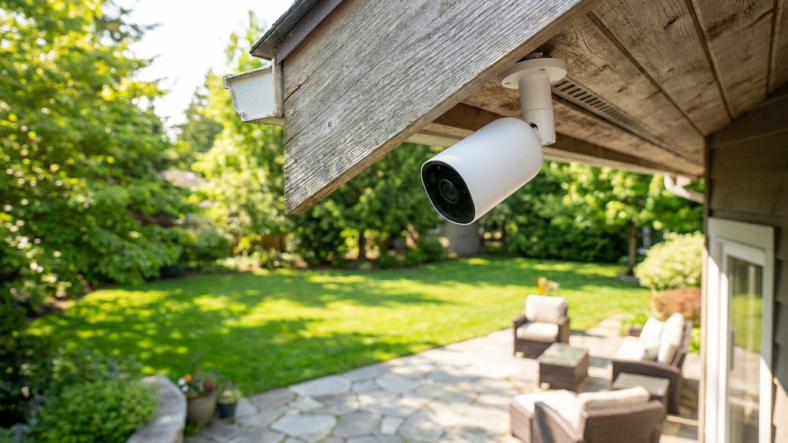
A camera mounted low behind a fence post fights the fence itself, plus any landscaping in front. Raise the mount so the antenna has a clear path toward your access point and you remove an obstruction without touching the network.
Line of sight beats raw distance. A camera 20 metres away with a clear view usually outperforms one 10 metres away behind a shed corner.
Why a Plug-In Extender Near a Window Falls Short
A consumer extender rebroadcasts whatever signal reaches it, so a window placement only helps if that window already gets a strong signal, rarely true for a device 30 metres out.
An extender also adds a second wireless hop, raising latency and drop risk where a live camera feed can least afford it. That differs from the detached-building case covered in extending wifi range to a garage or shed, where a building blocks signal rather than open air.
Why a PoE Access Point Is the Durable Fix
A Power over Ethernet access point mounted outdoors gets power and network from one cable run, so there’s no separate outlet near the camera and no wireless hop from the house. The wireless leg shrinks to a few metres instead of the whole yard.
That cable run typically ties into an ethernet switch that can supply PoE, keeping the setup on one backbone instead of stacking wireless relays.
Mesh Versus PoE Access Point for a Camera Setup
A mesh system spreads coverage using wireless backhaul between nodes, which suits phones and laptops moving around the yard. A fixed camera doesn’t move, so it needs a stable connection at one spot, not flexibility.
We compare these approaches generally in wifi extender versus mesh system. For fixed outdoor hardware, a wired PoE access point beats both once you cover more than one or two devices.
Frequently Asked Questions
Will a mesh node in a weatherproof enclosure fix the problem? It can help with clear line of sight, but most mesh nodes aren’t built for direct weather exposure, so an enclosure adds complexity a dedicated access point avoids.
Why does my camera work in summer but drop connection in winter? Cold and moisture affect antenna performance in cheaper hardware, and ice or snow on an enclosure can block signal that reached the device fine before.
Do outdoor speakers need the same fix as cameras? Yes, same distance and line-of-sight rules, though speakers need less bandwidth than video, so a stable 2.4GHz connection is usually enough.

Adriana Mercado is a writer who explores the intersection of science, futurism, and storytelling. She covers simulation theory, emerging technologies, strange biological discoveries, and the worlds created in sci-fi and fantasy. Her work focuses on curiosity, clear explanations, and uncovering ideas that sit just beyond the mainstream.