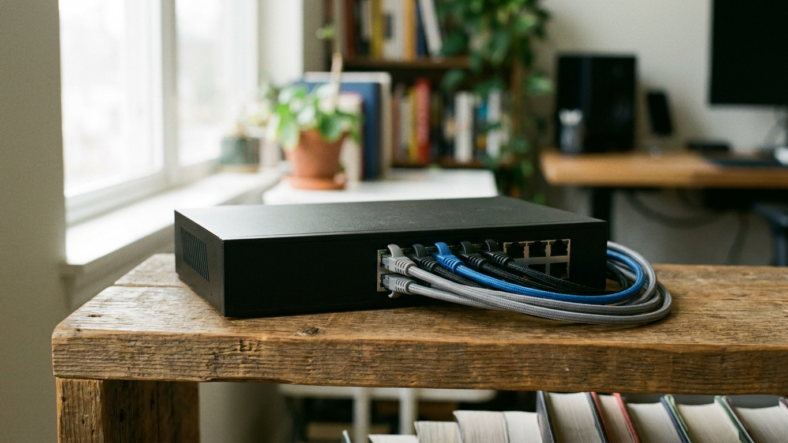


Nobody sells ethernet hubs anymore because switches solved every problem a hub created, at nearly the same price. A hub floods every packet out to every port at once and lets only one device talk at a time. A switch reads the destination and sends traffic straight to the right port, full speed, in both directions, at the same time.
You will probably never buy a hub by accident today. But the reason hubs died explains why your ethernet switch feels instant with a dozen devices plugged in, and why a “hub” in a junk drawer deserves a second look.
What a Hub Actually Did on the Wire
A hub operates at OSI layer 1, the physical layer, with no concept of a destination address. Every bit arriving on one port gets repeated out to every other port at once.
That design made a hub a shared collision domain. All connected devices sat on one half-duplex circuit, so only one device could transmit at a time without signals colliding.
Why Half-Duplex Killed Performance
Plug ten devices into a hub and they all divide one shared pipe. Add more devices, and each one waits longer for a clear moment to send data, since a hub cannot let two conversations happen on two ports at once.
A switch changed that math. Each port gets its own dedicated, full-duplex connection, so a device sends and receives at once without waiting its turn. Ten devices on a switch get a private path instead of fighting over one channel.
How a Switch Forwards Instead of Broadcasts
A switch operates at OSI layer 2 and builds a MAC address table by watching which device answers on which port. Once that table fills in, the switch sends each frame only to the port where the destination actually lives.
A hub never learns anything. It has no table and no memory of what is plugged in where, so broadcasting is the only trick it knows. That is also why an ethernet splitter and a hub behave nothing alike, even though people lump all “dumb” gear together.
The Security Problem Nobody Mentions
Because a hub repeats every frame to every port, any device plugged in could see every other device’s traffic just by listening. A switch closes that hole by design, not as a bolted-on feature. Traffic only reaches the port it is addressed to, so a device on port 3 never sees port 7’s data.
Where You Will Still Find One
Hubs survive in old lab equipment, training kits built to demonstrate collisions, and junk drawers holding gear from the 10BASE-T and early 100BASE-TX era. Shelves stopped stocking them once switch prices dropped to hub-level pricing.
Running new Cat 6 ethernet cable for a home network? A hub is not something to plan around. Every consumer box sold today under that name is functionally a switch.
Check the Label Before You Trust It
Cheap boxes at flea markets or hand-me-down gear sometimes still say “hub” on the case, but the electronics inside are almost always a switch. Manufacturers kept the word out of habit long after the hardware changed.
Copy a large file between two devices while a third stays active. A real hub chokes visibly, while a switch stays smooth.
Frequently Asked Questions
Can I still buy a real ethernet hub new?
Retail availability has mostly dried up. Nearly every product marketed with that name is a switch, since building a true layer 1 hub costs about the same as a switch now.
Will an old hub still work on a modern network?
Yes, technically, but every device sharing it drops to the slowest half-duplex behavior on the segment, and collisions slow the whole group down together.
Is a switch more expensive than a hub was?
Not meaningfully. Switch electronics became cheap enough that manufacturers stopped bothering to build the simpler hub circuitry at all.

Adriana Mercado is a writer who explores the intersection of science, futurism, and storytelling. She covers simulation theory, emerging technologies, strange biological discoveries, and the worlds created in sci-fi and fantasy. Her work focuses on curiosity, clear explanations, and uncovering ideas that sit just beyond the mainstream.