


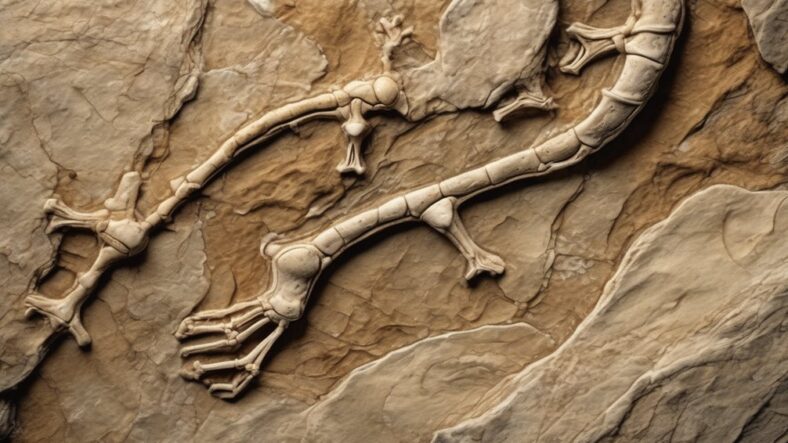
The Triassic Cuddle fossil offers rare evidence of early social behavior during the Triassic period. It shows two prehistoric creatures closely embracing, suggesting complex interactions like parental care, challenging the idea of solitary lifestyles back then. This discovery reshapes evolutionary theories by highlighting cooperation’s role in early species development. Found in well-preserved conditions, it also aids understanding of ancient environments. Exploring this fossil reveals new insights into prehistoric life and evolutionary processes.
Discovery and Significance of the Fossil
The discovery of the Triassic Cuddle fossil provided researchers with a rare glimpse into prehistoric behavior.
You can appreciate how the fossil anatomy reveals intricate details about the creatures involved, offering clues about their physical interactions.
Found within a well-preserved geological context, the fossil’s location helps establish its age and environment, essential for accurate interpretation.
This context lets you place the fossil within the broader timeline of the Triassic period, enhancing understanding of evolutionary processes.
Insights Into Triassic Period Behavior
Although direct observations of Triassic animal behavior are impossible, the fossilized interactions captured in the Triassic Cuddle offer valuable evidence to infer social and survival strategies.
You can see how these preserved moments suggest complex social interactions, including possible group behaviors. The close positioning of individuals implies parental care, indicating that nurturing offspring was part of their survival strategy.
Such findings challenge previous assumptions about solitary lifestyles during that era. By studying these fossils, you gain insight into how early animals may have relied on social bonds and care to navigate their environment, enhancing their chances of survival in the Triassic period.
Impact on Evolutionary Theories
Since fossil evidence like the Triassic Cuddle reveals unexpected social behaviors, it prompts a reevaluation of traditional evolutionary theories.
You’ll find that these findings carry significant evolutionary implications by challenging assumptions about how early species interacted and adapted. Understanding these behaviors helps clarify species relationships, showing that cooperation and social bonding may have played a larger role in evolution than previously thought.
This insight encourages you to reconsider how traits evolved not just for survival but for social cohesion.
Ultimately, the fossil reshapes your perspective on evolutionary pathways, highlighting complexity in early life forms’ development and interaction.
Future Research Directions and Questions
As new discoveries like the Triassic Cuddle challenge existing knowledge, researchers must explore several key questions to deepen our understanding of early social behaviors.
You’ll want to focus on how fossil preservation affects our interpretation of these behaviors, ensuring that the evidence accurately reflects ancient life.
Investigating the extent and patterns of behavioral evolution will help clarify how social interactions developed over time.
Future studies should also consider environmental factors influencing these behaviors.
Frequently Asked Questions
Where Is the Fossil Currently Displayed for Public Viewing?
You can find the fossil location at the Natural History Museum, where it’s on public exhibition. When you visit, you’ll freely explore this remarkable discovery, gaining insight into ancient life without restrictions or barriers.
Who Discovered the Triassic Cuddle Fossil Initially?
You’ll want to know that the fossil discovery was made by paleontologist Massimo Bernardi. He uncovered it, revealing its paleontological significance and giving you new freedom to explore early reptile behavior like never before.
What Materials Were Used to Preserve the Fossil?
You’ll find fossil preservation often involves using resin and plaster to stabilize delicate bones. Preservation techniques like these let you examine fossils freely without damage, ensuring you keep every detail intact for study and display.
How Large Is the Triassic Cuddle Fossil Specimen?
The Triassic Cuddle fossil specimen measures about 50 centimeters, roughly the size of a large textbook. When you consider its fossil dimensions, you’ll appreciate how this size comparison reveals its remarkable preservation and detail.
Are There Any Documentaries About the Triassic Cuddle Fossil?
Yes, you’ll find fossil documentaries and paleontology films featuring the Triassic Cuddle fossil. They’ll let you explore its story freely, diving deep into ancient life and the earth’s history from your own perspective.

Adriana Mercado is a writer who explores the intersection of science, futurism, and storytelling. She covers simulation theory, emerging technologies, strange biological discoveries, and the worlds created in sci-fi and fantasy. Her work focuses on curiosity, clear explanations, and uncovering ideas that sit just beyond the mainstream.